Prologue:
The Fading Empire of Everyday Things
Born from America’s post-war industrial production capacity and fueled by a massive domestic market, American capitalism built one of the world’s grandest machines. Enterprise began to codify, segment and expand production and market fit of consumer goods at a scale the world hadn’t seen. Goods that made life easier, faster, more enjoyable. Goods that were fairly priced for most households. Goods that were recognizable, meaningfully useful, and common. The collective industry behind these goods and the consumers that bought them began the Empire of Everyday Things.
These everyday things held a special role in society, precisely because they were common… and had strong relevance to the widest groups of people. Particularly in the U.S., there was almost a national unity in knowledge, and use, of everyday things. Not everyone was included in this development and everyday things certainly didn’t define America, but they did train the American consumer. Some goods were low cost and some were premium, but they were everyday things to everyday people. There were substitutable products, but each tended to have something about them that made them memorably distinct. This landscape of goods increasingly became part of a shared social fabric. And these everyday things kept coming. The microwaveable meal, the “just add an egg” cake mix, the bulk value pack. Real, tangible value invented, produced and sold at ever-increasing scale.
The peak of the Empire of Everyday Things was a simpler, less chaotic world that felt modern and progressive every time people shopped. A modern experience with modern niceties that made life easier, sometimes even better. Yet over time, this experience became subtly and slowly less defined by everyday things. No place demonstrates this key development in the empire better than the supermarket. Between 1975 and 2008, the number of products in the average supermarket swelled from an average of 8,948 to almost 47,000 according to the Food Marketing Institute. This speaks to a shift to a distinctly less simple world. The machine began optimizing for the wrong outputs and starving the inputs that once created value.
The point of this book is to illuminate a shift in capitalism that has compromised growth. Anyone working in the world of strategy, branding, innovation, marketing or consulting will recognize themes of the post-2020 world: total product categories are still “normalizing,” trends amplified during the pandemic are still rapidly shifting, corporate restructuring abounds, consumer opportunities are getting more expensive to unlock, tech is the only sector “delivering” scale growth.
Yet these themes didn’t begin with covid, they are signals that the consumerism machine is faltering.
The machine we’re analyzing is the system that turned routine into scale. It is the system that turned everyday needs into predictable market growth while shaping consumerism that fueled a more cohesive national identity. Through a century of consumerism, capitalism learned to mass-produce trust and to translate consumer routine into enterprise scale. But the same logic that made the system work has made it fragile and inefficient.
To understand capitalism’s best machine (and where it may need repair) requires understanding the intersection of culture and business… An intersection that is most legible through brands.
The irreducible core function of a brand is to provide a cue that reduces friction between buyer and seller. Brand is a recognizable trait associated with a potential experience that gains or loses meaning over time. The meaning that grows is generated by actual experience; people experience brands in the four Ps product, price, promotion and place.
Understanding the intersection of culture and business through brands therefore requires constant focus on one inherent blindspot: people who don’t purchase the brands.
True understanding of the consumer opportunity with a dedicated lens on both those who do and those who do not purchase a brand tends to be an academic pursuit. This broad analysis and evaluation rarely justifies significant focus for a growing brand or scale organization.
Yet this analysis is increasingly warranted, because capitalism broke its best machine. The symptoms are visible everywhere.
Many of the biggest and brightest brands of the last century are in decline. A decline in meaning. A decline in value. A decline in growth. A decline in buyers.
Many of these brands sit in the same sector: Consumer Packaged Goods (CPG).
Alder’s Razor states, “If something cannot be settled by experiment or observation, then it is not worthy of debate.” This book is built on what can be observed and what has already been tested: markets, behaviors, and outcomes, not abstractions.
Looking broadly at how brands are doing, 73% of consumers feel overwhelmed by too many choices, and 74% say they’ve walked away from a purchase because of it. More pointedly on how this has impacted society, more than a third of shoppers experience “aisle anxiety” when grocery shopping.
From 2020-2024, Pet Care, Home Care, Beverages, General Food, Beauty, Refrigerated, Frozen, General Merchandise, Health, Tobacco and Liquor all showed a decline in unit sales in the US.
So the CPG sector is struggling. Lots of sectors struggle. What makes reading this worth your time?
CPG brands are evolving organisms built to serve capitalism’s primary demand: growth. Whether growth as a fundamental reason for being feels fair, just, or moral isn’t up for debate in this book. What is up for debate, and what makes this worth examining, is why this growth has sputtered.
In terms of Total Shareholder Return, the CPG sector outperformed the S&P 500 every year (except 2005) from 2001 to 2012. The sector has not beat the S&P 500 since.
What do CPG leaders have to say about all this? In a 2025 survey of more than 200 CPG executives, 49% said their business model won’t be viable in a decade.
For the last two decades, I’ve worked to help global brands create growth by understanding and engineering the systems that manufacture consumption at scale. Diagnosing how a product becomes a ritual, how ritual becomes identity, and how identity converts to revenue. My expertise has been in illuminating, shaping, and inspiring these systems: the frameworks, the strategies, the products.
This book isn’t nostalgia or confession. It’s anatomy of how the logic that once sold soap, beer, and breakfast cereal eventually came to sell everything, including meaning itself. And how, somewhere along the way, the engine that powered growth started to consume the culture it claims to serve.
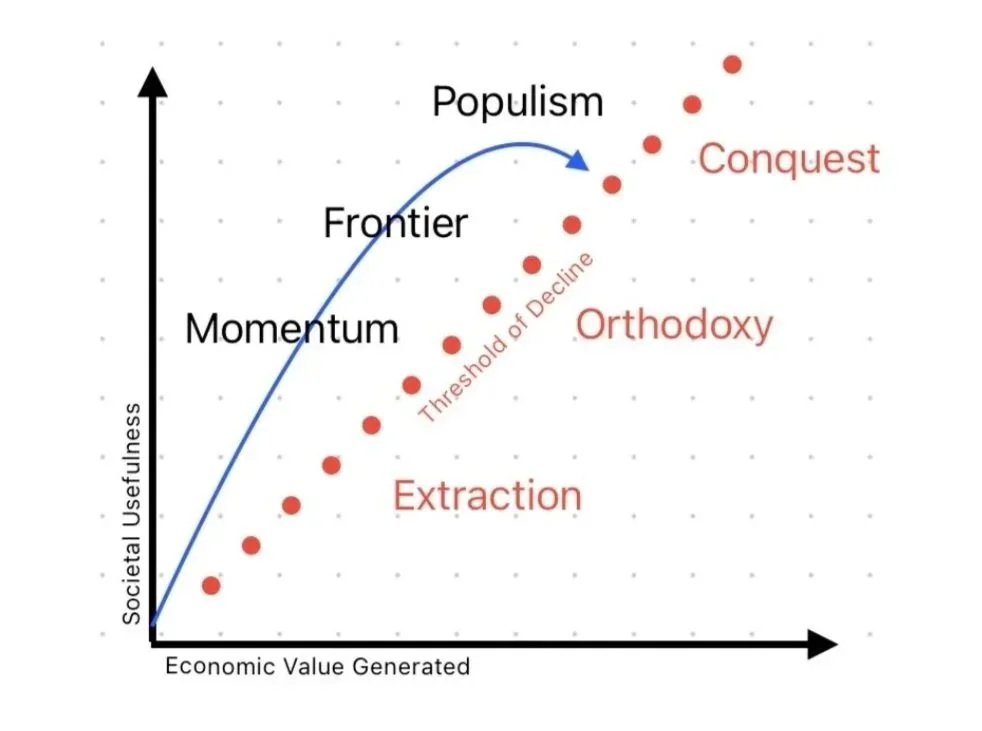
This book maps the system from the inside: the routines that once produced durable growth, the points where those routines now fall short, and the structural habits that quietly narrow who categories serve. The cases that follow aren’t prescriptions but evidence of how value is created, diluted, or siphoned away as markets mature. Across them, a pattern holds: industries stay healthy when usefulness and value rise together, and they weaken when economic ambition outpaces cultural relevance. When financial logic becomes the dominant operating mode, markets drift from the broad base that made them viable in the first place, and the distance shows up as shrinking reach, tightening recruitment, and a slow erosion of trust.
The Fading Empire of Everyday Things is a diagnosis on the faltering mechanics of consumption with a clear path to reigniting growth: stripping the system back to what actually creates value, discarding the incentives that hollowed it out, and rebuilding a model of growth grounded in usefulness, simplicity, and broad participation.
Trajectory of Growth
When value outpaces usefulness, categories behave like empires in decline: scale get traded for churn, and recruitment collapses long before the numbers show it.