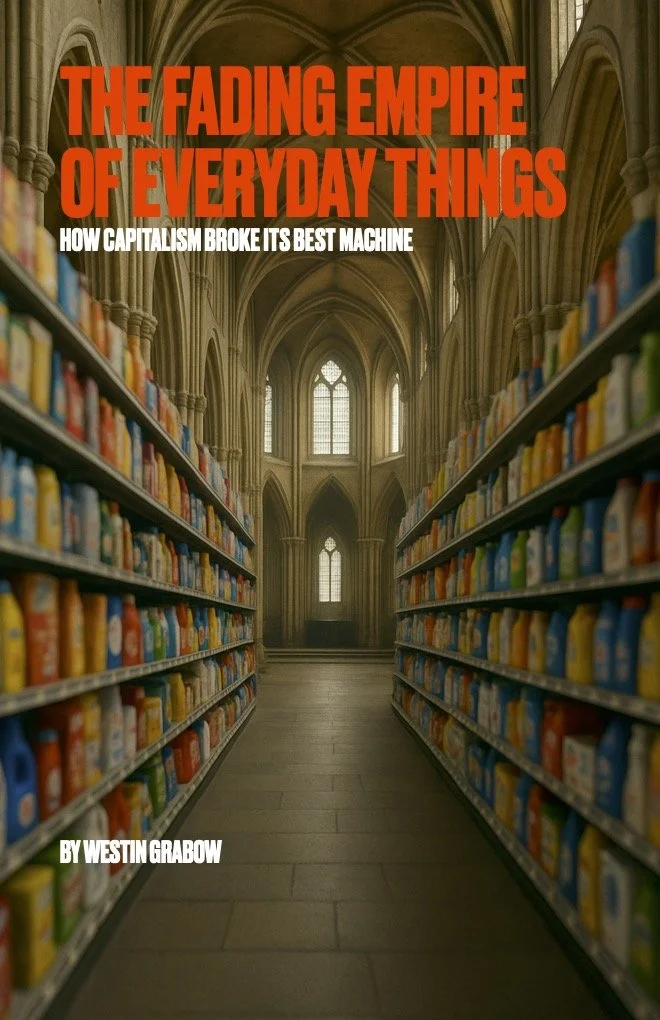
The Fading Empire of Everyday Things
How capitalism’s most reliable machine drifted out of alignment and how to reignite growth.
THE PROJECT
This book examines consumer packaged goods as the clearest window into modern capitalism. Not through nostalgia or sentiment, but through the operational logic that built a century of reliable growth—and the incentives that later hollowed it out.
WHY NOW
The signals are visible: stalled penetration, fragmented attention, pricing in place of progress, portfolios built for architecture rather than comprehension. These are not category problems. They are structural ones.
This book maps the shift and the path back to coherence.
WHAT THE BOOK PROVIDES
A narrative data-fueled framework showing how categories that optimize for additive expansion, create drag and narrow demand.
Diagnostic signals, mechanisms and the tensions needed for restoring growth in the modern market place:
Leverage - Applied (vs. Additive) at Center of the Category
Texture - Traction (vs. Friction) in Category User Experience
Clarity - Signal (vs. Noise) Irreducible Ease of Category Use
Force - Focused (vs. Diffused) use of Category System
ABOUT THE AUTHOR
Westin Grabow has spent two decades inside the global consumer system, building strategy, innovation, and category architecture for some of the world’s largest brands. The perspective is internal, structural, and focused on how systems behave—not how they are marketed.